Tuesday, July 28, 2009

My Top 6 Plants From The Caribbean, by James Henderson

Botanical gardens in the Caribbean are always a pleasure to visit. Tropical plants – particularly if you do not know them - are endlessly exotic. They are often incredibly brightly-coloured. Their flowers are weird and wonderful - some look more like sculptures than anything natural. Orchids are extraordinary. And who would ever design a flower like the lobster claw or the torch ginger? They might almost bite you.

There is a botanical garden in nearly every island, and in them nearly every plant has a story. I’d always recommend taking a guide when visiting them and when hiking (while elsewhere I am not necessarily convinced about guides). But here they bring the place alive with all the stories. These can be to do with the origins of the plants, where they came from and how they got to the Caribbean (see our recent newsletter article about Captain Bligh and the Plant Hunters), or how they grow. Also, what the plants are used for – many are used for medicinal purposes as well as for decoration and for food.

As you walk the around the garden a guide will crush leaves to reveal the smell (this is particularly good on citrus trees, but also on others such as clove and camphor) or they will point out oddities – you can guess what the red film of the lipstick palm looks as though it might be used for, but what about the sandbox tree – in fact it takes its name from its pods, which were once used for containing blotting sand (to dry ink on the page).

Here are few of my favourite Caribbean oddities, discovered in various botanical gardens over the years -

Quinine, used in the treatment of malaria, comes from the bark of the cinchona tree, which grows best in cloudforest - at high elevations.

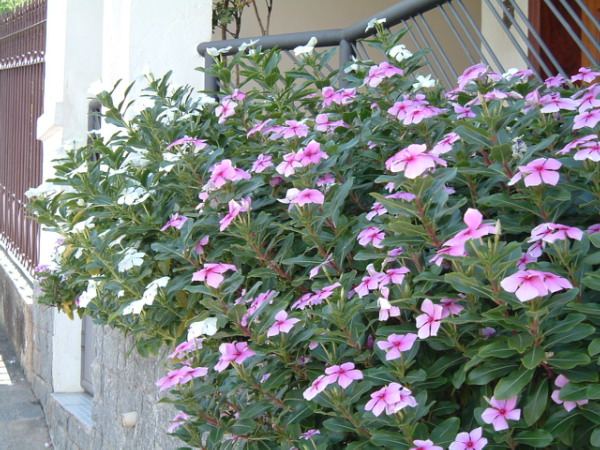
The periwinkle, a pretty pink flower on an unassuming green bush, has been used in the treatment of cancer.

Pimento, a spice that grows particularly well in Jamaica, is also called allspice (because it tastes like so many other spices combined – cinnamon, cloves and nutmeg for instance). The spice comes from the berries and the wood is used to flavor jerk food when cooking. Allspice can even be used to cure and dye leather.

What fruit would a cannonball tree give up? You’ve guessed it, a massive, woody ball. Interestingly this huge tree has very delicate flowers, which open at night and fall to the ground with the light of dawn.

Mahogany tree pods explode, releasing a spray of whirligig seeds (a bit like a sycamore).

In Haiti, one type of hibiscus is known as Choublac (literally ‘shoe-black’). In years past in this extremely poor country it was used to provide an inky black juice that could be used as a replacement shoe polish.

For more information see the Definitive Guide to Caribbean Gardens and Flowers.

Monday, July 20, 2009

Coconut milk - How to eat a coconut

We left you all hanging a month ago...as I handed back a coconut to the vendor...with a promise of more to come.

This time, with a mighty chop of his machete, he split the coconut right down the middle, and tore it into two with his hands. And then, with another slightly more delicate cut he sliced off a fan-shaped section of shell. After that he handed all the bits back to me.

This is the fun part of drinking a coconut. You use the small section of shell to scrape off the lining on the inside of the nut. This changes as the coconut ages. It starts off a thin film of jelly on the interior of the shell, but gradually as the liquid in the coconut dries out this hardens into a white flesh, first springy and then eventually into dry coconut – the sort used in confectionery or roasted to make coconut chips.

It was the reason that I had asked for a nut that was not too young. The lining on this nut was a quarter of an inch thick and it was just becoming firm. The fan-shaped slice slid under the layer of flesh perfectly, bringing it up in rinds as slippery and uncontrollable as small white fish. Eventually I managed to stuff them into my mouth.

Delicious.

Monday, July 13, 2009

Lignum Vitae - Wood of Life, Truncheon or Natural Viagra?

Any tree with the name lignum vitae - translated it means ‘the wood of life’ – is surely worth a nod of respect. But this is one to doff your cap to. Lignum vitae takes the word hardwood to a new level. It is a very hard wood indeed, 4500 on the Janka Scale of Hardness no less, according to Wikipedia (the next closest, Brazilian ebony, comes in at 3692 and teak gets a paltry 2330). Unsurprisingly lignum vitae is also known as ironwood.

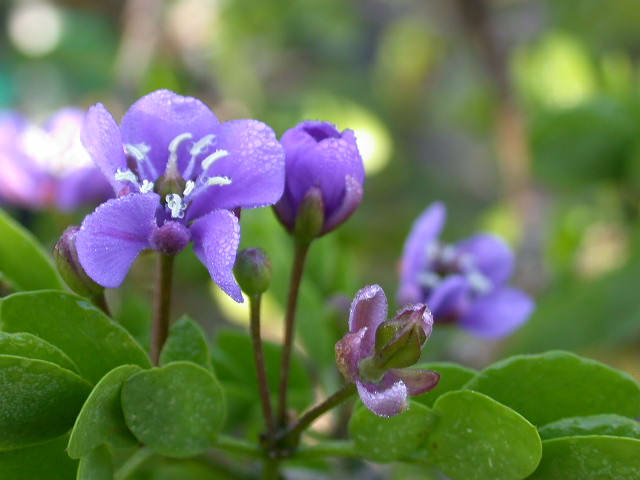
A native of tropical America, it grows on most of the large Caribbean islands. It has been adopted by the Jamaicans for their national flower – for what turns out to be a monster of a tree, it has a very delicate purple, five-petalled bloom. But here’s an example of how hard it is. Lignum vitae wood has been used as replacement ball bearings, even as an axle. It is quite resinous and so it lubricates itself, meaning that it works well in a marine environment, for pulleys and in working parts.

In the story of how Richard Lupinacci of The Hermitage came to Nevis in the 1960s, he talks of fighting his way through overgrowth to the old plantation house that turned out to be nearly 300 years old. The builder took a hammer and knocked the frame of the building and said - ‘Ah, lignum vitae, lignum vitae…’ Doubtless if it had been any other type of wood it would have been eaten by termites and fallen down long before.

Lignum vitae is also exceptionally heavy. And so it was used around the Caribbean for ballast in ships. Elsewhere it has been used for cricket bails and for British police truncheons. And there is another disarming quality to it too. The wood of lignum vitae is so heavy that it actually sinks in water (doubtless, like ice, it sinks in jack-iron too, see the article below).

For all of this, the name ‘wood of life’ apparently derives from the tree’s medicinal qualities rather than any physical prowess. The resin has been used for many years, in the treatment of arthritis and other ailments. At one stage it was thought to work both a contraceptive and a treatment for syphilis – and you can imagine, the naughtier calypsonians have had some fun with the idea of the strongest wood around. This stuff is so strong you can brew tea from the wood shavings. By gum, that’s probably harder even than Yorkshire Tea…

Monday, July 6, 2009

A Rum Old Ferry Ride

Of all the ferries you will encounter in the Caribbean, the most endearing one must be the twice-weekly link between Union Island to Carriacou in the Grenadines. It is a short hop, just a few miles, between two very small islands and so a small boat is appropriate. It is, or was, anyway, a small sailing boat with an engine – though last time I took it I had to help rig the sail. It’s a pleasant enough crossing - people come thousands of miles to sail in these waters for their holidays.

But it’s the unexpected things that happen that make travel in the Caribbean such fun. After I had helped to rig the jib (the sail at the front, anyway), the helmsman shuffled around the floor of the boat and pulled out a white plastic two-litre bottle. He thrust it at me.

‘Here, man, try a bit of the jack.’

I peered through the open neck of the bottle. Swilling around in the bottom was a viscous-looking liquid, slightly coloured, yellowish, but I couldn’t tell if that was the liquid or the suspension of particles that were bobbing around in it. There was organic matter in there too, small strips of greenery, all lined up like the sea grass on a current. I obviously looked doubtful.

‘It jack-iron man, the strongest rum you can get.’

It is true, jack iron is exceptionally strong rum, over 150 per cent proof. This particular (obviously unnamed) brand apparently didn’t come from Carriacou, where no jack iron was being produced at the time (officially anyway). Instead it came from Trinidad, where a big distillery has a small output. And yes, it was incredibly strong. It seemed to burn and then evaporate immediately, like some acid will ‘o the wisp.

But the most extraordinary thing about jack-iron is not its strength, rather the fact that ice sinks in it. I have seen it happen – it was on another occasion, this, there wasn’t much chance of the helmsman finding a coolbox on the floor too. Not that you’d want to drink a whole glass of jack-iron, but our host filled one up and then dropped two ice cubes into it. Instead of bobbing back to the surface and clinking against one another, they carried on to the bottom of the glass and swam around there for a few seconds before becoming still. Weird.

If anyone knows why ice sinks in jack-iron, please let us know why.

Tuesday, June 30, 2009

Review of The Blue Hour by Lilian Pizzichini (Bloomsbury)

The prospect of writing even a review of a biography for Jean Rhys is slightly scary. She wrote formidably depressing books, including a particularly lugubrious – if admirably clever - take on the Caribbean, Wide Sargasso Sea (she took the character of the mad creole woman, Rochester’s first wife, in the attic in Jane Eyre and told her story). And Rhys was well known as difficult person in real life. It is compelling material however. There is no doubt that for all her faults, Rhys is one of the leading lights of twentieth century writing in English.
Lilian Pizzichini’s new biography is sharply written and readable. It certainly doesn’t dispel any of Rhys’s reputation as a difficult person, but The Blue Hour is sympathetic in that it tries to understand why Rhys was how she was and it certainly does give an insight for the reader into her behaviour.


The book begins with Rhys’s return to Dominica as an established writer in 1936, using it as a springboard to describe her upbringing on the island and to start a generally chronological narrative. The point for Pizzichini is clear from the beginning, though. The facts of life in Dominica are merely stepping stones to help reveal the developing psychology of her subject. From the beginning she lays the ground out of which Rhys’s difficult character grows, presenting a logical train of events that makes her later actions and her bitterness the more inevitable.
Even before the author is a teenager, disappointment and happiness roll around in her like the proverbial cannon - her mother doesn’t love her, the island spirits terrify her, there is her father whom she idealises, but he is quickly followed by her wilful tantrums. There is early alienation, something that was to become a theme of her life. Dominican society was strict and her family was not quite respectable. And of course there were the obvious black and white issues too. And then there were men – abuse at the hands of a 70-year old and her early but complex forays into the power struggle between man and woman – as she saw it at least.
Rhys – actually born Ella Gwendoline Rhys Williams – was to become a classic outsider. It was true of almost every aspect of her life, but particularly because of her Caribbean heritage in a place that she couldn’t be a part of - one that she eventually hated – England.
Lilian Pizzichini has set herself the task of presenting ‘…the facts of Rhys’s life in such a way that the reader is left with an impression of what it was like to have lived such a life.’ And she does it well, and evocatively, though often imaginatively (because she simply cannot have known Rhys’s thoughts for sure). She has done considerable research into Rhys’s opinions though, and she then puts these into Rhys’s head, using indirect free speech, so that we see them from the inside. Additionally, much of Rhys’s writing, if not auto-biographical, was taken from life, so Pizzichini is able to use a number of the passages from her novels to describe Rhys’s actual life.
And there’s no doubt that Rhys led an extraordinary life. She went to England to complete her education and found that she hated it. She took to the fringes of Edwardian life – she couldn’t bear to commit to the core of its respectability – and became a chorus girl and dancer. This she was fascinated by and observed acutely, but of course she could not belong. She took lovers and was a prostitute in a manner of speaking. She married a Belgian crook and occasional spy and moved to Paris and Vienna. She knew some of the leading literary figures of the day. She became the lover of Ford Madox Ford (inevitably in a complicated ménage à trois with his long time lover Stella Bowen). Rhys lived life on the edge in so many ways.
Rhys had disappointments that would deeply have affected a normal person too - her baby boy died of pneumonia aged three weeks, and there were rejections by lovers – but they only served to increase her alienation and dissatisfaction. There was short-lived critical recognition around the Second World War - the critics acknowledged her talent as a writer, though her world view was simply too depressing for the time. Eventually she descended into drunkenness and sometimes violence, given to disputes with her neighbours and anti-English rants.
As the reader you really get to a sense of how complex and self-destructive she was when you come to sentences like this - ‘…she savoured the sweet bitterness of having been abandoned by so many loved ones.’ And ‘She always behaved badly when someone was nice to her because she had to pre-empt their inevitable abandonment of her.’
For all of this Rhys was also a charismatic and attractive figure. And lucky, too. She found many people who were resolutely kind to her and loyal. Of course she was innovative in her writing as well, though inevitably success was too long in coming.
So, did Dominica contribute to her character? She wrote about the island, and about colonial life. It was her one proper home, she said, though of course when she returned in 1936 she hated it. She fell out with the people there and saw her childhood dreams smashed to boot. But in a different way it pervaded the last years of her life – through her masterpiece, Wide Sargasso Sea and in a strange way, the story of this book strikes a subliminally positive note in a substantial part of Pizzichini’s narrative. It represents a well of latent success that simply has to spring forth and force aside the author’s unease with herself. The book stayed with Rhys for twenty or thirty years, bubbling under in her in tandem with her madness. It survived the burning of an early draft, but finally it came out in 1966 and she received the acclaim that was hers.
Generally The Blue Hour is a successful evocation of the woman. The impressions we get of being Jean Rhys are largely convincing and it is a compelling enough story to want to keep reading. Like Rhys’s novels it is frustrating, but that is less to do with the biographer than the material. It’s just hard to believe that someone, even the most sensitive of writers, could be so perverse and destructive to those around her -
‘… the person who was most against her was herself’.

The Blue Hour by Lilian Pizzichini is published by Bloomsbury. For more information, see www.Bloomsbury.com. For more information about Dominica, see the Definitive Caribbean Guide to Dominica.

Monday, June 22, 2009

Karst in the Caribbean - Cockpit Country

Karst is one of the Caribbean’s oddest geological features, a pattern of limestone that appears in several of the Greater Antilles and which has become a sight in its own right.

The rock (which takes its name from the Krs area of the former Yugoslavia) has been uplifted by tectonic movement and exposed to erosion. Any split in the rock has been exploited by the tropical rains, which have rushed through, carving and cutting holes, hollowing out caves and gradually dissolving the rock (limestone is soluble in acid). In places it has eroded in fairly regular patterns, leaving an extremely weird landscape. In Jamaica’s case, the Cockpit Country is like a massive, shaggy green eggbox that stretches for miles and miles.

The most famous sections of karst are the Viñales area of western Cuba, where the vertical walled outcrops marooned in the fertile plains are known as mogotes, and in the Dominican Republic, where there is a whole range of furry green lumps appear in the Los Haitises National Park in the north of the country. From above, the park looks like a very difficult green jigsaw. Similarly, in Puerto Rico there is a range eroded into the limestone plateau in the north of the island.

But the Cockpit Country is the most extensive of all. A flight from Montego Bay to Kingston flies above it, a sudden belt of uninterrupted and uninhabited green in an otherwise extremely populous country. In places the formations are as regular as an egg carton. It’s just that the indentations are 300 feet high and there are hundreds and hundreds of them.

The name Cockpit comes from a different assessment of their shape – the slopes of the peaks are steeply angled, creating pits between them which are just the shape of the auditorium for fighting cocks (a sport which doesn’t really exist in Jamaica any more, though it can still just be seen in some of the other islands).

Interestingly the Cockpit Country has other names too. The area was used by the Maroons (early runaways) when they were holding out against the British colonialists in the early 1700s. It was easy ambush country. In fact so dangerous that it was known as ‘the Land of the Look-Behind’- soldiers reputedly rode sitting back to back on horseback in order to defend themselves – and simply, chillingly ‘You no send, me no come’.

To get an idea of what the Cockpit Country looked like on a terrain map of Jamaica, see Google Maps.

Monday, June 15, 2009

Coconut milk - How to husk a coconut

It was the second time in a couple of days – and the second time in five entries on this blog as it happens – that I was greeted by a man brandishing a machete. There was nothing wrong with this...

The machete is one of the twin tools of the Caribbean, along with the umbrella. Every farmer needs one, to cut back the rampant growth. It’s just that it’s still a little unexpected when you’re in the street.

In this case it was needed to despatch a coconut. The man was standing next to an ice-cream trolley full of them.

‘Chop me a nut, sir!’ I said. ‘Not too young.’

And he delved into the trolley and pulled out a good looking yellow coconut.

It was at this point he whipped out his machete. He bounced the coconut in one hand, turning it until he got just the right angle. And then THWACK! He sliced off the top of the shell. It took him four or five strokes to slice it down to the right point and then he chopped slightly more gently, shaving chips off and preventing the coconut water splashing out when he broke through. He left a hole into the inside of the nut about an inch across, rimmed the white flesh of the coconut. At this point he handed it over.

It’s a messy procedure, drinking from a coconut. Not as messy as eating a mango (for which you are probably best to get into a bath, frankly, or the sea), but it is complicated. You have to squash the shell against your nose in order to get your mouth into position - and anyway the liquid always seems to find its way down your shirt. No worry, though. Coconut water is refreshing and satisfying in the heat and a nut can contain about half a pint so there is plenty there.

But there’s more to a coconut. I handed it back – it’s part of the service - and the salesman took out his machete again...

Friday, June 12, 2009

Jamaican Jerk - Take 2

You may remember my trip down memory lane about a month ago where I mused on the delights of Jamaican Jerk centres. Well, the marinade thickens. An email just landed on the desk from the Jamaica Tourist Authority with a press release introducing their ‘Jerk Trail - Jamaica's newest and spiciest!’ It talk about a culinary trail that you can follow as you make your way around the Island, with stop-offs at the places that offer the finest jerk.

The trail currently features eleven Jerk Centres, but I expect the list will expand … certainly Scotchie's in Montego Bay needs to be included! I’ve whiled away many an hour in there, soothing a sore tongue and gums (enflamed by hot pepper sauce) with a Red Stripe… Anyway, see below for some further details…

Supreme Jerk Centre, Green Island, Hanover
Located on the north-western tip of the island, Hanover is well known for agriculture, and sees the production of yams, sugar cane and breadfruit as well as ginger and pimento, some of the spices needed for the jerk marinade. Also it is celebrated for breeds of cattle, pigs and goats.

Border Jerk Centre, Ramble, Hanover

Ultimate Jerk Centre, Discovery Bay
Located on Jamaica's north coast, the huge Discovery Bay was originally named Puerto Seco (Dry Harbour) by Christopher Columbus. It is the site of the Discovery Bay Marine Laboratory, operated by the University of the West Indies, which was founded in 1965. The lab has hosted researchers from around the world focusing on coral reef biology and tropical coastal processes.

Scotchie's, Greenwich Park, Ocho Rios
Ocho Ríos (also known by the nickname Ochie), Spanish for Eight Rivers, is a town on the northern coast. It is a popular tourist destination, well known for scuba diving and other watersports.

Ocho Rios Jerk Centre

Lyming at Walkerswood, St. Ann's
Walkerswood is a small community in Ocho Rios, St Ann's which produces the popular Walkerswood Jerk Sauce. Today if you travel beyond Fern Gully, you'll see this small community. The efforts of this village can be found island-wide.

G&B Jerk Centre, Victoria Road, Kingston
Set on the southern shore, Kingston is the capital of Jamaica. It is visited primarily by business travellers, but it is the cultural heart of the island too. Take the time to visit the city … and its jerk centres.

Pon Di Corner Jerk Centre, Black Hill District, Port Antonio
As you would expect in Portland, the original home of the maroons, capital Port Antonio has several jerk centres. It lies on the north-eastern coast of Jamaica, about 60 miles (100 km) from the Capital, Kingston.

Blueberry Hill Jerk Centre, Port Antonio

Unique Jerk Centre, Hope Bay, Port Antonio

Boston Jerk, Boston Bay, Portland (finally!)
Boston Bay is known now as the home of Jerk. Located on Jamaica's north-eastern coast, it is rural and well known for its pretty beaches. The road is lined with Jerk Centres and you will see the meats being grilled in pits in the ground. Jerked foods are made with Jamaican jerk spices.


For some help with your trip through the jerk centres of Jamaica, get in touch with Rachel at Glamour Tours. If you fancy a read of my last trip to one in Boston Bay…check out Boston Bay is full of Jerks, Maroons and Buccaneers.

Monday, June 8, 2009

Kick ‘em Jenny - an active volcano in the Grenadines

Would you like to be called Kick ‘em Jenny ? It doesn’t sound exactly like a compliment... But this is no bronco, or any angry young woman for that matter. Kick ‘em Jenny is a stretch of rough water to the north of Grenada, in the Grenadines.

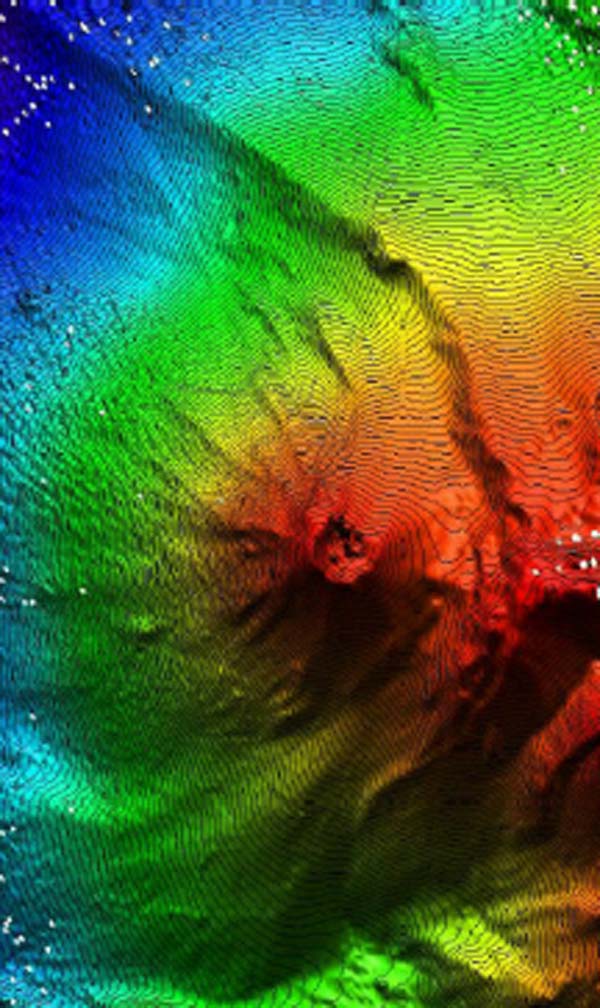
The reason for the name is that Kick ‘em Jenny is a submarine volcano. It rises over 4000 from the sea bed and comes to within about 600 feet of the surface of the sea. And the reason for the rough water is that the Atlantic currents stack up against this natural barrier, creating into an unpleasant swell on the surface. The name is reckoned to derive from the French /‘Caye qui me gêne’/, which means ‘island that disturbs me’, but frankly Kick ‘em Jenny is equally expressive. Certainly it can
feel like that it in a boat. In fact yacht companies ask you not to go there.

Like so many of the Caribbean volcanoes, Kick ‘em Jenny is relatively active and it often features on the seismic data collected in the area. But people notice it too. Pilots report seeing activity when flying over the area – bubbles and submarine clouds of debris. Grumbling noises are also occasionally heard on land nearby.

The most recent major eruption was in 1939, when ash and steam broke the surface of the sea, spewing and steaming and setting off tsunamis in the area. Since then there have been a dozen significant eruptions, most recently in 2001. According to the vulcanologists, in the years to come another Grenadine may eventually appear.

Monday, June 1, 2009

The Bahamas by Mailboat...

Few people who visit the Bahamas ever hear of Potter’s Cay, though many pass within a few yards of it each time that they are whisked off Paradise Island in one of those ridiculous white stretch limos that are so popular in Nassau. Where Paradise Island is fabricated Caribbean perfection -- massive casino, glitz and high-rise hotels -- Potter’s Cay is its alter-ego, a shabby looking area of working docks beneath the bridge.

Potter’s Quay is the main mail-boat dock that links the central Bahamian island of New Providence, where the capital Nassau is situated, to all the Out Islands, the literally hundreds of islands, ribbons of rock and sandbars spread over 100,000 square miles of the spectacularly blue Bahamian sea. After Nassau it is a reminder that real West Indian life does exist in the Bahamas after all.

The mailboats are the Out Islanders’ lifeline. Pretty much every tea-bag, breeze-block, can of condensed milk and car that reaches them is transported this way. And that’s not to forget the mail of course, some of which also travels by sea. They also take passengers if requested, which makes a novel way of travelling around the islands. As many of them travel overnight, you even get a cheap (well, comparatively, it is the Bahamas) bunk for the night.

With a departure scheduled for 5pm I was a little panicked when Bahamas Air thrummed into Nassau Airport two hours late, at five minutes to five. But this is the Bahamas. When I finally pitched up, Bahamas Daybreak III, 120 foot long, destination Governor’s Harbour and Rock Sound in Eleuthera, was still surrounded by piles of cargo.

There was all the chaos of the dock: shouts of instruction, jokes and high five greetings and in the background a small stereo screaming tinny dancehall rap -- Murderer! A fork lift truck beetled back and forth lifting pallets on board, which were then shunted or hefted by men: bread in crates, breezeblocks, bags of cement, tile grout and kitty litter, tinned fruits from Trinidad, sacks of iodised salt, industrial boxes of M&Ms, slabs of Sprite. There were pot plants, films for the cinema (Black Hawk Down, Snow Dogs), private packages for Eric Cooper and Mr Hesley Johnson, and bags of onions, asparagus tips and boxes of wine for the hotels. The mailboats have been known to take coffins and even a horse or two, but tonight’s most exotic charge, swinging beneath the bow-crane, was a Bahamas Police Jeep – its motto Courage, Integrity, Loyalty stamped on its door.

Loading was clearly going to continue for some time yet. I headed off to grab some food, passing boats headed for Exuma, Bimini (Hemingway’s hangout in Islands in the Stream) and the delightfully named Ragged Island. Under the stanchions of Paradise Island bridge are a line of stalls selling fried fish and the local speciality cracked conch. Conch comes out of its shell, a bit like a dalek, as a rubbery handkerchief with a claw. It is tough so it is battered (with a hammer) and then battered again (with batter) before being deep fried and served with hot pepper sauce.

Eventually Bahamas Daybreak III left, in darkness, just a couple of hours late. We glided past the sailing yachts, fishing boats and the gin palaces into the open sea, leaving the Paradise Island high-rises behind. A full moon lit the calm sea up for miles around.

The captain allowed me up into the wheelhouse, where there was a bank of machines, radar, gps, depth sounders, automatic pilot. When I asked about the weather he paused and looked at the sky. I was poised for a nugget of sailor’s wisdom, for a moment:

‘Ah doan know. Mi didn’ look at de forecast.’

It looked pretty flat anyway.

He described the route, following a string of romantic sounding ‘cays’: Rose Island, Booby Rocks, Samphire, Six Shilling… The whole trip crossed the Great Bahama Bank, where the sea is never more than about 30 feet deep. It is also drug and desperation territory. One mailboat captain, cruising along on a pitch black night, actually sliced a boat of Haitian refugees in half. In their bid to reach America undetected they were travelling overloaded, without lights.

We docked before first light and the unloading began. The dock at Governor’s Harbour was soon littered with piles of goods. At dawn the shop-owners, hotel managers and private individuals expecting packages appeared, loaded their pick-ups and sped off. The bread truck arrived. Mr Hesley Johnson’s boxes sat for a while and then were gone. One man cussed the captain for bringing the wrong cargo and another searched the boat for a door-frame that simply wasn’t there. By nine the dock was nearly clear and Bahamas Daybreak III was on its way to Rock Sound in the south of the island.
Bookmark and Share
Related Posts with Thumbnails