Monday, October 5, 2009

Review of Jamaica Farewell by Morris Cargill (1978, Barricade Books, 1995)

Jamaica Farewell is an exceptionally touching memoir of a man in the process of leaving an island to which he belongs. It was the 1970s, politically a difficult time around the Caribbean, and many of the wealthy islanders were leaving because they saw no future there. For Cargill the situation was even more poignant because he was writing commentaries in the newspaper about the situation and it was getting him in trouble. Eventually he felt he had to go. This is his tribute to an island that he so obviously loves.

His writing is clear and direct, so it is generally easy to read. At the same time it is strongly opinionated – as the man himself obviously was. His columns in the Jamaica Gleaner were testament to that. But given that the pleasure of reading has a good deal to do with enjoyment too, it is important that it is shot through with generous good humour. It starts with – and then is peppered with throughout - the funny stories of happenstance and eccentricity that seem to occur more in Jamaica than anywhere else. Cargill is also a sharp observer, whether it be the curious lilt of Jamaican language or the learning behaviour of bananaquits (he sees them learning to hover like hummingbirds to get at nectar).

Viewed from the perspective of the early 21st Century, Jamaica Farewell can seem paternalistic, even patronising, but it doesn’t take long for the true spirit of the man to come through. Actually Cargill was a rebel and a radical in his day. He scandalised white Jamaican society by adopting a black child and he introduced radical new worker conditions on his plantation. And he was hard-hitting when he wanted to be, relentlessly pursuing causes in which he believed. He was known in the 1970s as one of the scourges of the Manley government for his columns in the Gleaner. At times you can feel the columnist warming to his theme in Jamaica Farewell, whether it be drugs or the remorseless purgatives in Victorian English medicine. Occasionally they jar slightly in the writing – perhaps because he knows he is being contentious – but mostly they are seamless and of course they often lighten the book with obvious good humour.

The key emotions of the memoir however are eternal. It is clear to feel the man’s love for a country which he can see going to hell in a handcart (then a very popular streetside vending platform in Jamaica) – shortages, election fraud and for him personally threats of prosecution for being anti-government in his writings. He has done what he can and so he decides to leave – for an uncertain future in New York.

Most of us are visitors to the Caribbean. While we are stunned by the beauty of the islands – and Jamaica is among the most beautiful - and we are usually impressed by the people, we only see the surface. Jamaica Farewell is very well written and an immensely touching book that will illustrate the attachment of West Indians to their islands.

Often it turns out to be an unavoidable bond. Two years after leaving, Morris Cargill returned, living out the rest of his life there.

Monday, September 28, 2009

Retractabelt Limbo - Arrivals in Nassau

Airports are mostly pretty faceless, sterile places, despite what Alain de Botton (recently writer in residence at Terminal 5) would have us believe. The terminals are generally pretty ugly and people are usually tired, children fractious and suitcases (mine anyway) always seem to be last out onto the carousel. I find I just want to get through them as quickly as possible.

Which makes it all the more delightful when a moment arises - something surprising, ironic, illogical or comic. One happened to me recently in Nassau in the Bahamas (after the BA flight out of Terminal 5 as it happens). It didn’t start well, but by the end I was spellbound in bemused fascination, not knowing whether to squirm and join in or run for it.

Heading for the Arrivals Hall I passed the string band – traditional instruments, tropical shirts and straw hats – and I noticed a small kerfuffle in the corner of my eye. A woman, from a previous flight by the look of it, was clearly so taken by this reception committee that she simply had to dance. The band were happy enough to play along. And the pirate compere, who was swashbuckling around, engaging new arrivals in the mind-blowing excitement of being in the Bahamas, giving out brochures and advice, was loving it. I guess it brightened up his day no end.

I managed to sidle by into the main Immigration hall, and into the maze of retractabelts that keep you going back and forth, left and right, covering about two hundred yards in a building just twenty yards across. Presumably a bored official sets them up to be as long as possible, despite there being little chance of a sudden influx of a thousand desperate passengers who need to be kept in order. But I had this inkling that trouble was about to follow me.

Things were momentarily uneventful … left twenty yards… right twenty yards… left twenty yards… oh bollocks, I can’t be bothered with this... I just removed the belts from their stands and rehooked them and made my way up to the yellow line that way. I joined the five couples standing there patiently.

Moments later there was a slip sliding behind me and a slightly monotone hum. Along with the others I looked around. And couldn’t help but smile. The dancing woman was doing a limbo under the retractabelt tapes, all six of them, and was gradually making her way up to the yellow line. Her mother (I suspect) tried one, thought better of it, and then went around the long way, back and forth, encouraging her on at each straight.

They joined the Immigration behind me, puffed but still humming the tune. Don’t Stop the Carnival, I think it was… There was an engaging rebelliousness about them, but soon came a moment of panic. Was she about to ask me to dance? Luckily her mum chipped in. They were off to the Atlantis. I knew the one, the huge theme park hotel on Paradise Island - yes, the waterslide passes through the shark lagoon. Yikes, I thought, I wonder if they’ll survive (the sharks, I mean).

Not me. I’ve always thought the best of the Bahamas was the out islands and so I was headed further afield as soon as I got through the Immigration queue. Actually I was off to kayak along the Exumas. But that’s another story...

Monday, September 21, 2009

Caribbean Citrus Fruit - Shaddock, Tangor, Ortanique

As you’d expect, there are many different types of citrus fruit in the Caribbean. You’ll see them in colourful piles in the markets - limes, lemons, oranges (or ‘greens’ as some of them ought to be known) and grapefruits. And you can have fun picking and crushing their leaves. They release an oily but tangy citrus smell.

Ugli Fruit - Courtesy of Cooking by the Seat of my PantsBut in Jamaica you will find other citrus fruits besides these, and they have their own idiosyncratic names. The shaddock, for instance, which is closely related to the grapefruit. Elsewhere it is known as the pomelo, but here it took this name from the Seventeenth Century English ship’s captain that introduced it to the island. And the tangor, as it is known in the rest of the world, a hybrid of the tangerine and a sweet orange. This name is just so much prosaic nonsense to the Jamiacans. For them it is an ortanique, part orange and part tangerine finished off with the -ique of unique.

And finally there is the delightfully named ugli fruit, which is exactly what its name says it is, a squat fruit with a nobbled and warty skin. It is a hybrid of a grapefruit, the orange and a tangerine. And just to prove the expression - beauty really is only skin deep in this case – its flesh is not ugly at all, but juicy and pleasant.

Monday, September 14, 2009

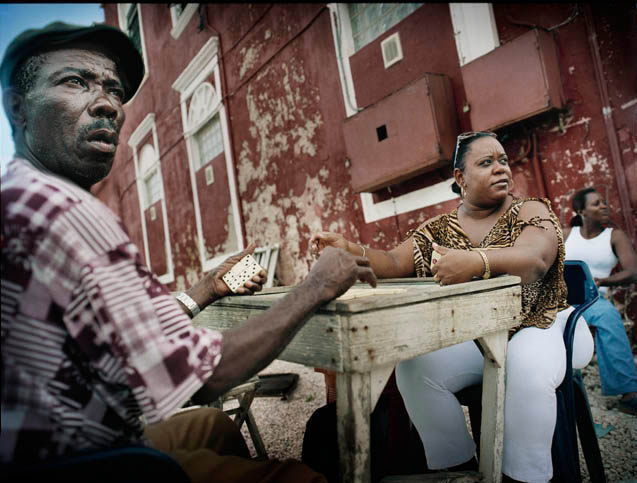
Caribbean Dominos - A Game of Slap and Slide!

Dominos is an all-Caribbean game, played from Cayman round to Curaçao, and particularly via Cuba, where even El Jefe, Fidel Castro, was known to be partial to a game.

You will see it in action in bars around the islands, at taxi stands and under trees on afternoons of leisure.

Actually, more accurately, you will hear it being played – West Indian dominoes is played with customary Caribbean demonstrativeness. A ‘card’ as it is called in Barbados, is not laid down on the game table. Most of the time it is slapped down and then slid into place.

It looks so simple...and yet...there is far more strategizing than you would ever imagine, and most importantly there is also an active mind at work. Even players clearly the worse for wear - or is that the worse for beer? - will be counting off the dominoes that have already been used and finessing the ones that remain, judging who might be holding them.

A word of warning, then. Do not ever, ever, take a West Indian on at dominos for money. Regular players just beat you every time.

Interested in the game rules? Have a look at John McLeod's Rules of Domino games: Jamaican and Caribbean Dominoes.

Monday, September 7, 2009

Irony in the Islands - Caribbean Maps Come Alive

It’s an eccentric view, to be sure, but I have often imagined the Caribbean islands as an animal skeleton. It sits, looking left, perched at Jamaica, its body Hispaniola (Haiti and the Dominican Republic) and its head and neck, Cuba, stretching out towards Mexico. Balanced by its tail, the many island vertebrae of the Eastern Caribbean, the western end of Cuba might be about to peck Cancun.

I wonder what animal it might be. It could be an iguana perhaps, or a tree-dwelling cat. But then its tail is prehensile - Trinidad is embedded, holding firm onto Venezuela in South America – so perhaps it is a tree porcupine or a pangolin – though it looks too ready to leap. It might even be a chameleon or a dinosaur. The Bahamas, which admittedly stand ceremonious on the fact that they are not actually part of the Caribbean, do look like one of those brightly coloured fan-shaped backplates.

Individual islands have their ironies too. Jamaica looks like a turtle, languishing calmly in the sea, momentarily surfacing to breathe – and it’s an image about as inappropriate as it is possible to be for the frenetic, ever-lively Jamaicans. Guadeloupe is well known as a butterfly (and there are nautical confusions there too), but its compatriot Martinique looks more like a flea in mid-leap. Or is that a skiing glove? And St Kitts and Nevis, in true form, are like bat and ball. All it would take is for St Kitts to pivot around its handle and it would knock Nevis into the mid-Atlantic.

But my favourite image is that of Cuba, which from the perspective of the rest of the Caribbean looks like an alligator hovering over them, threatening. It’s true, Cuba could be scary – as soon as it opens up fully it will threaten to swallow their livelihood by taking all their tourism. With one switch of its tail it could descend on them and gobble them all up. But then step back a bit and you will see the incisor of Florida hanging over Cuba, poised to chomp onto the Yucatan and bite it in half. And suddenly Cuba looks like a wriggling tiddler. And so it has been for the past 50 years. Thing is, looking at the map, Cuba might just manage to get away.

Tuesday, September 1, 2009

Harum Scarum - Caribbean Flight Frights

As a group of islands, you’d expect the Caribbean to have some, well... ‘sporting’ landing strips. And so it turns out. There are short runways, runways with cross-winds, runways with cliffs at either end, and runways that inconveniently have a hill in the way, just where you’d want the pilot to line up to land.

We have tested them all and have put together a roll of honour – the Caribbean’s top three scariest landings! And here they are. Enjoy...


1 St Maarten
There’s a rather short approach to this runway, so the beach-goers get a bit of a shock from time to time.

2 St Barths
You worry that as it comes in to land the plane will take the hat of the car drivers on the road below.

3 Culebra, off Puerto Rico
And yes, there’s a hill just where you want the pilot to line up here, so you swing around the hillside.

And before you go, if you would like to read a story about landing on Saba, a bright green pimple of an island whose airstrip is shorter than any self-respecting aircraft carrier, then have a look at Landing on Saba - Not Something for the Sane! which is the fourth video in the above playlist.

Monday, August 24, 2009

Firefly - Light Emiting Diode or Lights Emits Dies

Of all the weird and wonderful instances of insect behaviour found around the Caribbean – and there are ‘Hercules’ beetles six inches long in Dominica and ancient insects millions of years old caught in amber in the Dominican Republic – one of the loveliest and most distinctive is the firefly. To see one, meandering across your bedroom at night, or flickering in the garden, is one of those moments that give a feeling of real privilege.

Officially the firefly belongs to the family lamprydae, but of course it takes its common name from its characteristic of flashing at night. Which is of course a mating display. Males fly around flashing, in the hope of impressing a female on a nearby leaf. And if she likes the quality of the flash – apparently some are sexier than others - then she will reply with a responsive flash after a specific time period.

Generally Fireflies like dank, forested areas, particularly around streams and in gullies for instance (Fern Gully leading out of Ocho Rios in Jamaica used to have hundreds, but the petrol fumes have done for them now apparently). Equally they can be seen in gardens (near ponds and rivers). I was told once that they have just twenty minutes of ‘flash’, after which, it was said, they die. A high risk strategy, then.

Put two fireflies together and they will often flash in time. There are places in the world (though I have not heard of one in the Caribbean itself) where whole riverbanks of trees flash in time – on for a second, off for a second, on for a second, off. In the Caribbean you will have to be happy to see them individually. And, hopefully for them, in flash-induced pairs.

Monday, August 17, 2009

How to Eat an Orange - Markets in Santo Domingo

West Indians certainly do sales with aplomb. Market stalls are as carefully presented as art galleries. You might see a range of colour co-ordinated cigarette packets, a pyramid of avocados or a clutch of umbrellas all carefully leaning against one another so as not to fall down.

And if the set is worthy of a stage, then there is certainly drama and the ‘lyric’, with a constant backchat and sales patter, to bamboozle you into buying. Coconut salesmen call and shout then chop coconuts for you with a flourish of their machete and when you buy a snow cone in Jamaica you can expect the third degree – all to get a cup of crushed ice flavoured with some concentrate to give it taste.

But in the Dominican Republic they have what must be the most stylish way of... well, peeling an orange. It is a small metal machine. You fix the orange into a clamp and then start to wind – all with a theatrical flourish of course – and a sharp scoop then begins to cut into the peel, shedding the orange (or often green) skin right down to the bottom layer of pith, leaving a neat serrated pattern of rings. Chop the orange in half and you can scrape the flesh of the orange out with your front teeth. Perfect.

Returning to my favourite orange seller in Santo Domingo not long ago, I found that he had upgraded. Not the same at all, I thought. The old machine, the one he wound with a flourish, had been forsaken and instead there was a battery driven one, with a motor in the spiral shape of a huge inner ear. But hey, he executed it all with the same dexterity and drama. And the orange was as juicy and sweet as ever before.

Monday, August 10, 2009

How to Eat a Mango - Or Survive The Guadarun!

Plenty of types of fruit can be a bit messy to eat, but none surely tops a mango, for which frankly you need a bib? Or possibly swimming trunks. I met a person who jokingly said that they are best eaten in the bath. Another went as far as to say they were best in the sea. Apparently the salt of the water on your hands improves the flavour, complementing the sweetness of the mango.

In addition to being the messiest fruit, mangoes are surely also the most exotic. They are impossibly sweet when they are ripe, and their satin skin has the most amazing and inviting range of colours. From green (even then they can also be used, in chutneys, for instance) they turn yellow and orange, then a hundred shades of blushing red. Some take on an outrageous, luscious pink. There are scores of varieties. The most popular ones around the Caribbean are the Alphonso, Julie and the Number 11. It’s always worth getting hold of one. In terms of taste they are in a different league from anything you can buy in a supermarket at home.

It must have been the God of contrariness that designed that stone, which is shaped like a cuttlefish skeleton. And those filaments, which stick in your teeth, leaving you clicking for the rest of the day trying to get rid of them. But once you become a devotee you take these things in your stride. Actually, opening a mango, sectioning half the flesh within its skin and turning it inside out like a hedgehog is quite fun, particularly if there are children around.

All of which leads, in a roundabout way, to my personal favourite mango-eating moment. It was in Guadeloupe, at the very end of the Guadarun, a 150km staged running race that takes place on five islands around the archipelago over six days. You run on beaches, brutal burnt rocky terrain and over the not inconsiderable mountains (one stage resulted in a ‘personal worst’ marathon time of eight hours 32 minutes, but then there was 9000 feet of climbing). All in the tropical heat of course.

The final stretch of the race runs along the cliffs of the eastern edge of Grande-Terre (it’s the easterly of the two islands, see an explanation of Guadeloupean geographical oddities). After 30 kilometres running in the sun – it was so hot that even the clouds had evaporated - the course turned down into a cove, coming to a finish on a beach. Here I was handed a vast pink and red mango and a knife. Picture then, an exhausted ultra runner now ecstatic - knowing that the challenge is now defeated - sitting in a rockpool up to his waist, mango juice dripping down his chin. Never has a mango tasted so good. Nor been as messy.

Monday, August 3, 2009

Landing on Saba - Not something for the sane!

I am sitting on a veranda in St Maarten shooting the breeze, after a formal interview, with an old resident of the island. I mention my upcoming visit to Saba (my first, back in 1989). Saba is one of the other Dutch Windwards. It stands on the sea horizon somewhere just out of sight. Jokingly, I express concern about the landing.

Just to let you know some key facts - at 400 metres the airstrip is extremely short, it sits on the only (nearly) flat bit of land on the island – it’s still on a slope, though - on a promontory with a 150ft drop at one end and a 350 ft drop at the other. You don’t want to mis-time it, anyway. As you’ll see in the clip below there can be cross-winds too. They make you want to lean forward and tap the pilot on the shoulder and say –

‘Excuse me, I just think you ought to know, the runway’s over there.’

Sure, they have special STOL aircraft (Short Take Off and Landing), usually Twin Otters, which anyway are fantastically manoeuvrable, and the pilots have to retrain every ten minutes – and you know they want to crash even less than you do – all that bureaucracy... But still it’s a nervous moment, landing on a strip shorter than most self-respecting aircraft carriers.

Eventually the conversation was concluded by my wizened interviewee, in a voice that was calm, if slightly dead-pan, no lugubrious... or was that apocalyptic?

‘Doan worry, man,’ he intones. ‘They only use half the runway...’

Unfortunately, when I landed, they decided to use the second half of the runway...

When you’re dangling in mid air, seemingly on a piece of string tweaked by a malevolent air sprite, runways seem deceptively small. My mind shuffles quickly – fine, there’s the island, but where the actual landing strip? Hold on, he can’t mean that postage stamp, surely? Oh, he does? Well, you’re coming in far too steep, mate – manoeuvrability maybe, but you’re going to overshoot. At least he is pointing along the runway, so the cross-winds aren’t too bad. But then a blast buffets us from the side and we lurch left. He brings it back on line admirably quickly, but still he is aiming too far down the strip. I am sure of it.

By now he is gliding. We slide high over the cliff at the start of the runway, past the windsock, then 100 yards later past the terminal building with its diminutive fire engine. Eventually we touch down half way along the landing strip. Alarms beep all over the place. The woman next to me in Row One put her face in her hands and her husband goes into rictus, bolt upright with an electrified expression. And then there is something as close to panic as I have seen in a pilot. His faces furrows in concentration. He proceeds with his drills, putting on reverse thrust and the brakes at the same time. The plane roars, strains and judders under the load.

Suddenly a tyre bursts, and we begin to bounce sideways as well, slewing right. Finally we come to a halt. The pilot takes in a deep breath... And lets it out again... Sanguine feller. Later, my joke ran that when you opened the door you closed it again... having decided to get out the other side of the plane because of the 400 foot drop with no steps, but actually it wasn’t quite that bad. We have come to a halt, at forty-five degrees to the runway, with about fifteen yards to spare. That’s maximum runway utilization, but not much room for comfort. We walked to the terminal building wobbly legged. Except the man next to me, who is still stiff and moving like a mummy.

Welcome to Saba. Oh, I nearly forgot. What’s Saba actually like? Well it’s great. Odd but intriguing to visit. Once you’ve got there that is...

If you’re not up for the adventure, you can actually go by boat nowadays. Meanwhile, enjoy the video clip of a landing at Juancho E. Yrausquin Airport.
Bookmark and Share
Related Posts with Thumbnails