Showing posts with label Caribbean Life. Show all posts

Thursday, September 30, 2010

Elizabeth "Ma Pampo" Israel - Dominica's Oldest Woman

Time waits for no man, but for dear old ladies in distant Dominica defying the ravages of age is all part of the natural process. Elizabeth Israel became the world’s oldest woman on authentic record when celebrating her 125th birthday on Jan 27th 2000 and, while agelessness is often misconstrued, in her case it seemed entirely appropriate. She never did enter the Guinness Book of Records though, the authorities decreeing that the lack of a birth certificate, which disappeared in a hurricane, precluded it despite a clear account in the local baptismal register. I know - I once spent three days sourcing it before spotting the original entry.

“Even the old people here knew her as an old woman”, said Lucien Da Silva, a long time neighbour in the Glanvillia tenantry near Portsmouth, “and I always felt she was a very special lady”. The register at St John and St Lewis Catholic Church also identified Louisia Frager as godmother and the date of birth as January 27th 1875 but many people in the village actually thought her much older. She was probably one of the last direct descendants of a slave, her mother Magdelaine Israel, a tall “redskin” from Antigua speaking Kokoy dialect, was brought to work on the Morne Talin plantation near Colihaut on the west coast. The terrible 1838 hurricane required a switch to the Picard estate near Portsmouth where she lived to more than a hundred herself. Something in the genes then, or are there other reasons?

When I met Ma Pampo, as she was known to one and all, she was blind but her recollection for times past still sharply acute. On the eve of her 125th I asked what had been the secret. “Well”, she chortled, “I ate callalloo, dumpling, meat, lots of fish and crab”. Sitting straight backed, upright in bed, cuddling a toy Dalmatian, she was listening to the radio in her humble two roomed chattel house. “An doan forget de coconut milk an dasheen either!” Finally, she advised “never eat a heavy meal after 6pm, then drink a bush tea. Fertilizers are making people weak”.

Raised with four siblings, she got up early, drank pure water and went to work at Picard aged 25, picking peas for 2/6d per month. A penny for a nine hour day. Rough trails were the only means of communication, no electricity, no telephone, and Roseau could have been another country, but she recalled her only trip to the capital 20 miles to the south. “My wedding day, and we went by the estate boat”. She bore a son Burleigh Codrington who died at 30 though a grandson Charlesworth lives in England. Pampo was known as Minetta George for a while after marrying Ernest, and remembered “walking to work and being turned back if you weren’t over dat bridge when bell rang at 7am.” Graduating to supervisor, she directed ox carts and the grinding mill, and organised lime, vanilla and coconut processing. “I danced the cacao too,” referring to the now rarely practised cocoa polishing with the feet manoeuvre. She avoided alcohol as a girl, and smoked tobacco in a clay pipe instead. Pampo preached simplicity, honesty, good faith and health care, with humour, patience and kindness never far behind.

In 1979, still strong and agile at 104, she took redundancy from Picard, lived alone and was revered throughout the neighbourhood, a classic case of care in the community, her life led at one with the soil, sustained by diligence, diet and an unfettered environment. “She was a sharing, kindly person”, Martha Martin said, “and the only lady who was never called witch by the children”. Suddenly the old radio crackled into life, a gruff voice from Roseau exhorting “we want Pampo down here to talk!” “Me gwan nowhere”, laughed Pampo, “dem haffa come to here”. Tributes poured in later from far and wide, and there was banter around 25 missing telegrams from the Queen.

People like Pampo are not unusual in Dominica. Just round the corner, I was introduced to Ms Rose Peters, a mere stripling at 117, who had sorted cacao with Pampo, still walked down the lane, chatted to everyone and prayed twice a day. A further four of her close associates were also centenarians, (there are currently over twenty others, three times the ratio of western developed countries), testament to the strength of its motto: After God, the Earth. Israel embodied Dominican toil and spirit from another era, sadly passing away in 2003 aged 128 after complications arising from a pedicure.

Thursday, September 9, 2010

Hurricane Allen and other pleasant Caribbean Hurricanes!

We’re half way through the hurricane season and so far so good, for the most part anyway. Despite projections of a greater incidence than usual in this era of changing global weather and climate, the anticipated flurry of storms has not transpired despite the battering of the northern Leewards and Virgin Gorda last week by Hurricane Earl. Antigua and St Maarten had trees flattened and power outages, parts of the Virgins suffered substantial damage and restaurants and other buildings on Frigate Bay in St Kitts were lashed by heavy rain and high winds. It could have been worse, so let’s hope the status quo continues.

The period is one of fear and loathing for many in the Caribbean, the several thousands who live in less sturdy accommodation, though satellite tracking systems now give ample early warning and time for safety measures which the old time West Indian simply did not have. Seeing out a powerful hurricane then was a matter of experience, good fortune and trusting in the shelter as much as anything else. As an ingénue in Barbados in 1979, I awoke one morning to find everywhere covered in a thick red dust, blown over from the erupting Soufriere volcano in St Vincent. It was a startling revelation, something quite out of the ordinary, disturbing to the status quo. Not long afterwards something far more traumatic and personal assailed Little England, the first indication and realisation that perhaps all was not sweetness and fine light in these balmy isles.

Sundays then were reserved for beach cricket, and that alone, and Bathsheba on the east coast the chosen destination once a month. This one morning, someone rang advising against it, mentioning a brewing storm which the dogs accepted but not the mad Englishmen relishing the noonday sun. Beautiful day, over Farley Hill we drove, past Morgan Lewis mill and down to that glorious foreshore on the most atmospheric part of the island. Things were blissful till around mid-afternoon when suddenly the wind whipped up and the sea got angry. Even then, as someone used to rough weather in the Pennines, often for months on end, I wasn’t unduly concerned. The game continued, though one or two of the more enlightened decided to head back to Bridgetown and the south coast.

A hardy Irishman Mr David O’Flynn lingered with me, but eventually we too were forced to repair to the Edgewater Inn for sustenance. Soon after, we were about to set off for the west coast when the proprietor hailed us, obviously worried: “no one can leave now, you’ll die” were his words of admonishment, spoken in all seriousness and registering like no other. “It’s a hurricane now, and heading our way fast”. We were forced to bed down for the night along with a score of others on mattresses scattered on the floor. It was humourous at first, until we heard a St Lucia radio broadcast echoing through the bar area “Ok Barbados, signing off here, the Caribbean is with you, the Lord God too, we trust there’ll be minimal damage”. By now it was dusk, doors and windows were barricaded and taped, the wind howling like a banshee, the rain driving horizontally.

The Edgewater was built of solid coral stone blocks on a cliff edge high above the roaring ocean, seemingly exposed to the raw elements but in defiance of all the weather could muster and probably one of the safest structures on the island. As darkness fell I took one last glimpse of the world beyond through a chink in one of the thick porthole glass windows. The vision that appeared shocked me to the core - Hurricane Allen was upon us, in all its fury. As far as the eye could see out to the horizon, gigantic lines of white topped breakers tumbled shoreward, immense battalions of them, twice the size of houses. To the right down the coast road, coconut trees were bent at ninety degrees, snapping amidships when the force became too great and scattering their cargo like bouncing bombs, chattel houses had their corrugated roofs peeled back like sardine tins, then torn asunder and flung to the heavens.

A sleepless night ensued, followed by a long, surreal journey back to the west coast later the next day, clearing roads of debris, matchwood trees and people’s belongings. I was dropped off at my place on Gibbs Beach, incredulous at the scene that awaited - a palm tree had toppled right across the car, a write off, the gently sloping beach had all but disappeared, replaced by a 20 feet high cliff, and my cottage awash with smashed cutlery, broken trees and foliage forced through open louvres stupidly left open. My cat clung on terrified at the top of what remained of some flimsy curtains. Twas a salutary sight, an awakening to the awesome power of nature. It was deemed a glancing blow, not even the full impact. In Dominica, people still talk of “David”, in Jamaica of “Gilbert”, reverentially in a way, out of respect. Hurricanes. Don’t underestimate them and ignore them at your peril. Heed any warnings and batten the hatches.

Tuesday, July 20, 2010

Dominica Traffic - Caribbean Norm or Witches Curse?

It’s everywhere you go. Even the Caribbean has more than its share nowadays, though Anguilla is never overburdened and several of the smaller islands beyond the capital cities are usually untrammelled. We’re talking traffic, lots of it. Kingston Jamaica, Port of Spain Trinidad, Bridgetown Barbados, Castries St Lucia are increasingly clogged with cars as journey to work times continue to expand.

Last week I experienced a strange variation on the theme. The narrow one way systems of Dominica’s main town of Roseau are rarely congested, unless one of the giant cruise liners just happens to have docked at the waterfront, but this was not one of those days. I’d pootled into town from Goodwill in the north, clattered over the river bridge into Queen Mary Street and was quietly minding my own business when the light traffic in front inexplicably ground to a halt.

There was no obvious obstruction ahead, no breakdown, no minor collision or stray dog, just some sort of impasse. It happens all the time of course around the islands, drivers passing the time of day with each other, handing parcels over etc., just as you want to get somewhere fast. I could see passengers gazing sideways where people were thronging the porticoed sidewalk in steadily growing numbers so I turned off the engine, sat awhile because there was no option, and strained to see what the fuss was about.

Eventually, with time ticking on, I leaned out and inquired of a sensible looking citizen “whappen down de road, sir?” His response was immediate, and throwaway; “Nuttin’ much sah, a witch jussa block de footpath” ! Whhaaaaaat?? Apparently then, if a pedestrian comes face to face with a witch, black or white, it’s common courtesy to pass to her right so you won’t be affected by any spell. If she doesn’t allow it, a stand-off ensues and a blockade develops. This had just happened, effectively bringing the whole of downtown Roseau to a halt as drivers stopped to await the outcome.

They may still be there, it wouldn’t surprise me; nobody was budging so I somehow manoeuvred a nifty reverse and made my getaway down a sidestreet. You’d think stories like this were apocryphal but here they’re commonplace. In Elma Napier’s wonderful evocation of a 1930’s bohemian colonial life here in “Black and White Sands” published by Papillote press last year, she muses “it has never been easy to analyse, to define the mysterious charm that has lured some people to stay in Dominica forever, and from which others have fled without even taking time to unpack”. Incidents like this at least give us a clue. Yes, Dominica’s different, very different.

Monday, June 28, 2010

Carriacou Regatta 2010, 25th July – 2nd August

No island in the region can cherish its links to the sea more than Carriacou, the southernmost of the Grenadine chain twenty miles north of Grenada. Known as the Land of Reefs by the original Amerindians, it has a strong Scottish and Irish heritage and seafaring is in the blood. The building of traditional timber sloops is undergoing something of a renaissance too and Carriacou’s hugely anticipated Regatta is due to celebrate its 45th anniversary from July 31st over the Emancipation holiday weekend.

It’s developed into a popular event drawing sailors and visitors alike from Grenada, Tobago, Canouan, Union, Martinique, St Vincent and from as far north as Antigua in a raucous festival of seamanship and good natured bonhomie. Inaugurated by Jamaican John Linton Riggs, to help stimulate the boat building trade, his large workboat the Mermaid, constructed by master shipwright Zepherine McLauren, once won seven regattas on the trot. These sturdy workboats remain the focal point today and are raced in four different classes up to 35 feet in length.

Other sporting and cultural events take place on land and fierce competition is the order of the day. There may even be the odd flagon of Jack Iron rum consumed. For more information do call 443 7930 or 7948 or email on ccouregatta@spiceisle.com.

Tuesday, June 1, 2010

Coke, Golding and ‘Politricks’ in Kingston, Jamaica ain’t all bad!

Something topical this week – the news from Kingston, Jamaica is alarming but would you have a clue it was happening if you were in the Blue Mountains, Negril or Montego Bay? We read the views of specialist Caribbean writer Stephen Thorpe, who has been writing about the Caribbean in the UK national press, magazines and international publications for over 25 years.


It’s certainly unusual these days for the Caribbean to feature on primetime and international news bulletins—so when it does, we sit up and take notice. The news out of Jamaica recently however has not made for good reading, or watching for that matter, but it’s important we retain some perspective on the matter. The problems besetting the downtown areas of the capital Kingston are multi-facetted, socially complex and rooted in political machination and corruption spanning more than four decades, a long term cancer at the heart of society. Jamaica is arguably the most arresting, visually inspiring and creative country in the entire region with 99% of its population warm and welcoming, and a sporting pedigree globally unparalleled for its size yet since Independence in 1962 it has been seriously under served by its politicians.

Last week’s horrendous scenes emanating from Tivoli Gardens have scarred Jamaica’s international image once again but this time, whisper it, there may be some sort of positive repercussions. It never rains but it pours—the hurricane season starts on June 2 with a forecast, as ever, for more frequent storm passages too. Ah, Tivoli Gardens. Sounds like some Italianate Eden, replete with fountains and blooming bougainvillea. Er...... no, far from it, it’s a sweltering concrete slum and shanty area housing thousands, abutting nearby Trenchtown, Jones Town and Rema where conditions are no less harsh. No need to rake over the grizzly details, but large swathes of west Kingston are controlled as lawless fiefdoms by drug barons and gun runners, the garrison “dons”, one of whom Christopher “Dudus” Coke, was summoned for extradition by the US back in October.

Prime Minister Bruce Golding of the Jamaica Labour Party and constituent member for Tivoli resisted it, but finally relented unleashing a street war when the residents blockaded the area against government forces and police seeking Coke. He has still not been located. If history repeats itself (and let’s hope it doesn’t) standby for more inevitable unrest. In 1992 Coke’s father, Lester, aka Jim Brown, died in a mysterious fire in prison the day before he was due to be extradited. Your correspondent witnessed the funeral: at the head of the cortege was Edward Seaga, one of Golding’s JLP predecessors as Prime Minister. Draw your own conclusions.

In the 1970’s Seaga opposed Michael Manley’s Peoples National Party which was supposedly aligned with Marxism and Castro’s Cuba and not to the liking of the United States. Guns flooded in from the north setting the tone for present day street culture; even now there are downtown walls smeared with old graffiti from that time: “CIAga Land, Keep Out”. Got to hand it to Jamaicans for retaining their sense of humour in parlous times. The common man refers to “politricks” and “politricians”, and not without good cause. As a former long term Kingston resident I trod carefully in those downtown enclaves, meeting remarkable people like Pastor Bobby Wilmot and Lorna Stanley who gave up a successful 30 year career in Washington journalism to return and offer succour and advice to the “sufferahs” of Trenchtown. These and other brave people like them are undeniably the true warriors of social conscience, not those now supposedly leading the country.

So, what does the future hold for the benighted Land Of Jah ? For the first time in years the police have a presence in Tivoli, so that’s a departure of sorts. And what about prospective travellers, the two million visitors per year, the lifeblood of the tourist industry? Kingston and St.Andrew is still under a state of emergency but at Moondance, Rockhouse and Tensing Pen in sultry Negril, the vibe is unaffected; indeed in every coastal resort, from Jake's and the unspoiled rural backwater of St.Elizabeth in the south to Strawberry Hill and the dreamy Blue Mountains life goes on as normal. The word must still be: go, and savour the upliftment.

For information about where to stay and what to do in Jamaica, have a look at The Definitive Caribbean Guide to Jamaica.

Definitive Caribbean says, fly into Montego Bay and from there choose from a number of other worthy places to stay, where the troubles in Kingston will seem a world away: Coyaba Beach Resort, Country Beach Cottages, Half Moon Club, Jackie's on the Reef, Round Hill Hotel and Villas, Moon Dance Cliffs Resort and Spa, The Caves and villas through Linda Smith Villas and Villa Vacation.

Monday, December 21, 2009

A Merry Caribbean Christmas

As we look forward to a break for Christmas (well, except for our partners in the Caribbean, who can expect their workload to increase with the Christmas visitors, of course), we thought we would share our Christmas card with you. And for a bit of sunny Caribbean fun, see below.

Merry Christmas from all of us at Definitive Caribbean.


Here’s a Merry Christmas in the dancehalls of Jamaica – /Great Tidings from Natty Dread!/ - courtesy of Mike Dread TV and Jacob Miller.

Thursday, December 3, 2009

Jamaican Slang and Caribbean Proverbs

The West Indians have always been lyrical and laconic. And they have a lovely turn of phrase, using things that surround them to near poetic effect, even when they are cussing you out. For a bit of fun we have collected some well known West Indian expressions, proverbs and sayings. Some even make into calypsos. One which did is –

"The higher the monkey climb, the more he expose..." (or ‘the more ‘e show ‘e tail’ in Barbados)

The more you show off, the more your faults are visible to those around you, or the more successful you become, the more you are under scrutiny. But, in Jamaica -

"Monkey know which tree to climb."

The ambitious person knows where to apply their energy. And while on the subject of animals -

"Evah pig got a Saturday."

Everyone will pay for his deeds at some point. And -

"Horse dead and cow fat..." In a long story it is used in the sense of ‘and so on and so forth’.

And then you add

"...and donkey maugre."

For islanders there is particular significance in -

"De sea ain't got nuh back door."

The sea is not a safe place so you need to take precautions. And the Jamaicans again -

"Dem go together like batty and bench."

Two peas in a pod. It seems that crows get bad press in the Caribbean. The Trinidadians will have it that if -

"Corbeau pee on yuh"

Nothing will go right, you have a hex working on you. The Jamaicans call crows ‘John Crows’ and delight in referring to moonshine rum, distilled but completely un-aged and un-mellow, as -

"John Crow Batty"

"Well, Cheese on Bread!"

(Barbadian amazement!)

Monday, November 16, 2009

Good Morning - A Lesson in Manners

It’s one of those aspects of West Indian life. You are expected to greet people, when you meet them. Even if you don’t know them. It sometimes seems odd, coming from a big city in which people barely even look one another in the eye. But in the islands, people say hello when they pass in the street, often from the opposite sides of the road, despite the fact that they do not know the other person. People even say good-morning when then get on a bus in some islands, to an assembled company of people they don’t know. An exchange cannot pass properly until you have.

I found myself standing in a bakery in Roseau in Dominica, waiting my turn to buy a rock cake and one of the island’s fantastic juices this time, for a belated breakfast. I am surrounded by schoolchildren who are on their break. I am about to make my order when all goes quiet. A ‘big man’ walks in. he is covered with gold. Perhaps he is a hood. They all seem to know him, anyway. He walks straight up to the counter and says:

‘Gimme a pattie. Beef.’ He points.

There is a pause, as the lady behind the counter holds his eye. Two seconds, three, four...

‘Good morning’, she says.

It stops him in his tracks. Suddenly everyone is minutely interested in the signs on the wall, anything but the main counter. He says good morning before he asks her more politely.

Oooh what a put down...

Monday, September 14, 2009

Caribbean Dominos - A Game of Slap and Slide!

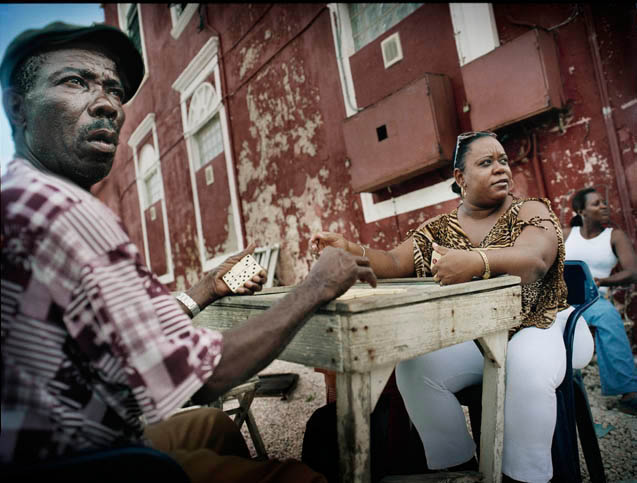
Dominos is an all-Caribbean game, played from Cayman round to Curaçao, and particularly via Cuba, where even El Jefe, Fidel Castro, was known to be partial to a game.

You will see it in action in bars around the islands, at taxi stands and under trees on afternoons of leisure.

Actually, more accurately, you will hear it being played – West Indian dominoes is played with customary Caribbean demonstrativeness. A ‘card’ as it is called in Barbados, is not laid down on the game table. Most of the time it is slapped down and then slid into place.

It looks so simple...and yet...there is far more strategizing than you would ever imagine, and most importantly there is also an active mind at work. Even players clearly the worse for wear - or is that the worse for beer? - will be counting off the dominoes that have already been used and finessing the ones that remain, judging who might be holding them.

A word of warning, then. Do not ever, ever, take a West Indian on at dominos for money. Regular players just beat you every time.

Interested in the game rules? Have a look at John McLeod's Rules of Domino games: Jamaican and Caribbean Dominoes.

Monday, June 15, 2009

Coconut milk - How to husk a coconut

It was the second time in a couple of days – and the second time in five entries on this blog as it happens – that I was greeted by a man brandishing a machete. There was nothing wrong with this...

The machete is one of the twin tools of the Caribbean, along with the umbrella. Every farmer needs one, to cut back the rampant growth. It’s just that it’s still a little unexpected when you’re in the street.

In this case it was needed to despatch a coconut. The man was standing next to an ice-cream trolley full of them.

‘Chop me a nut, sir!’ I said. ‘Not too young.’

And he delved into the trolley and pulled out a good looking yellow coconut.

It was at this point he whipped out his machete. He bounced the coconut in one hand, turning it until he got just the right angle. And then THWACK! He sliced off the top of the shell. It took him four or five strokes to slice it down to the right point and then he chopped slightly more gently, shaving chips off and preventing the coconut water splashing out when he broke through. He left a hole into the inside of the nut about an inch across, rimmed the white flesh of the coconut. At this point he handed it over.

It’s a messy procedure, drinking from a coconut. Not as messy as eating a mango (for which you are probably best to get into a bath, frankly, or the sea), but it is complicated. You have to squash the shell against your nose in order to get your mouth into position - and anyway the liquid always seems to find its way down your shirt. No worry, though. Coconut water is refreshing and satisfying in the heat and a nut can contain about half a pint so there is plenty there.

But there’s more to a coconut. I handed it back – it’s part of the service - and the salesman took out his machete again...

Monday, April 20, 2009

On the Bus - Caribbean Style! Part 2

You see names on buses all over the Caribbean. Some islands go in for it more than others, but they offer a good insight into Caribbean life.

In fact in Haiti they go far further than just naming their buses, They dress them up like circus lorries. But there is usually a religious slogan written on the front and side in Kweyol (Haitain Creole). Hey, it’s comforting to know, as you walk carelessly across a road that was empty a nano-second before, and look up to discover you are about to be run over by a super-charged gypsy caravan, that the last thing you read will be a blessing -

Béni Soit l’Eternel (Blessed is the Eternal Lord).

On one bus I saw the word Nissan written right underneath. Translated it would mean -

Blessed is the Eternal Nissan - not such a comforting thought to die with, unless you’re a Japanese salaryman possibly.

In most islands buses have a simple name, sometimes the driver’s nickname (most West Indians have them). In St Vincent recently you had the pleasure of nearly being run over by – or to be fair, getting a ride in -

Captain Sess, Rasta Ride, Freddy or Zion.

Or it might be Diplomat. Who knows how that got its name - a foreign ministry official turned taximan? His other car is a Diplomat? And Squeala? Does that come from the agonised screeching of his tyres, as he takes off to his next destination. Or was he involved in a B-movie and spilled the beans under torture. And what about the delightfully named Random?

Other names speak of the drivers’ (sometimes inestimable) self esteem - not to forget their driving prowess, no doubt -

No Fear! Shy Guy (yeah, likely), Xtreme and Rush.

And others are just plain surreal, but have a certain catchiness – no doubt they are the coolest bus in town –and therefore the one you definitely want to ride. What would it mean to ride in -

Code Red?

But my favourite name for a bus was always Not Guilty, Your Honour!, a bus that would ply its trade – or is that roar off in a cloud of grey exhaust? - along the west coast main road in Barbados. Perhaps it was a form of rebellion. You can just imagine the driver, in trouble again, standing in the dock,

"Are you, Mr John Smith, the driver of bus named Not Guilty, Your Honour? And did you drive Not Guilty, Your Honour at speeds without the specifications of the law? And have you anything to say in your defence…?"

The whole court would be in hysterics!

Monday, March 16, 2009

On the bus - Caribbean style!

Riding the buses in the Caribbean has always been a good exposure to local West Indian life. Of course, most West Indians avoid them like the plague, calling them hot, crowded and noisy (they’d prefer to be in an air-conditioned car, mostly), but for a traveller they are always an adventure, a source of local gossip and an intravenous plug into the current musical hits.

Expect a lively ride… You’ll see them coming, bobbing and weaving in the traffic, squeezing through any gap in which they can fit – and a few they can’t! Out on the open road they perform all the same manoeuvres at high speed, running the central line in second gear as they prepare to floor the accelerator to get another rung up the traffic – it’s another reason that West Indians avoid them if they can.

But they are also fun. Things happen to you when you are out and about in the Caribbean. In Jamaica, sitting passengers are simply given things to hold for ‘standees’ – schoolbooks, shopping, anything goes, they drop it on your lap. Once, as a man in my late thirties, I was sitting quietly, to find myself handed a baby. Both he and his mother just smiled sweetly at me while I wondered what exactly I was supposed to do.

There is a magical quality to West Indian buses. You must understand that in terms of a departure schedule, well there is none, usually. Departure times are a near-mystical calculation – a carefully weighed balance in the driver’s mind, of how many passengers are sitting in his (usually his) bus at a given moment, against how many he thinks he can pick up on the way. Oh, then the decision is filtered through his boredom threshold, and whether there is someone, usually a slim 20 year old, whom he can impress with his driving as he roars off.

But most of all, Caribbean buses are like mobile discotheques. You can sometimes hear them coming before you can see them, with a thump, thump, thump that echoes down the valley. Inside they are incredibly loud, and the chassis reverberates to the latest tunes. Sometimes you get the idea that the stereo is worth more than the bus itself.

Actually it got out of hand recently in a number of islands. In Trinidad – those contrary Trinis don’t have mini-buses by the way, they have maxi-taxis - there were stories of school-children skipping food so that they could spend their lunch money on a bus-ride. Anyway, the rude-boys were having it too good and so the moral majority came out fighting. They got the banned music in the buses in several islands.

And so it was that I stepped onto a ZR van once, which was running along the south coast of Barbados. Tinted windows, oversize wheels and the shift and tick of cymbals and a bass thrum that threatened. The driver – hair shaved into a Nike tick, gold teeth with Nike tick, dark glasses on a cloudy day - his sidekick, a conductor of sorts - communicating in a sign language, all pointing – it was all a bit intimidating, really, not to say confusing.

Driver was doing all the wrong things. He was stopping in the middle of the road to pick up and let down, honking at old folk not travelling at the mandatory speed (very fast). But then, blow me down, if he didn’t veer off the road - on two wheels, I think - and grind his way through the backstreets of Inch Marlow. Suddenly he screeched to a halt at a small house – all to let down a lady so that she didn’t have to carry her shopping all the way from the main road. Bless.

Here is our guide to Caribbean local transport.
Bookmark and Share
Related Posts with Thumbnails