Friday, November 13, 2009

World Travel Market 2009 - A Precursor

Whoops. Apologies for the oversight this week. No entry for the Definitive Caribbean blog.

You’ll be glad to know, however, we have been using our time well at World Travel Market, a travel trade fair, which is a travel experience in itself. Literally every country in the world is represented there and has its stand. You can go from South America to the Philippines and then via the Ukraine to Australia without jetlag - well, nearly, as the whole experience is frankly pretty boggling and exhausting to be honest. The building itself seem to work like a psychological vortex, sapping energy in a thoroughly twenty-first century way.

But among all the business, attending has its moments. The Lithuanians had a green dragon this year. I saw him pick some poor unfortunate and follow them until they ran and hid. On the Brazilian stand they were dancing. And in the Caribbean area, well… some time in the afternoon, they did as they always do, have a party.

And of course, to top off the entertainment, there are the baroque activities of the transport system that gets you there (or possibly doesn’t), the Docklands Light Railway. Actually it wasn’t so bad this year.

The purpose – to collect information about what’s new in the Caribbean for the coming season… Look out for our report to come.

Monday, November 2, 2009

Jet Lag - Can it work in your favour?

Flights to the Caribbean from Europe leave in the middle of the day. It’s not exactly a normal time to go to sleep, but in my case – as I’ve usually packed late into the night before - I doze off when there’s a moment’s quiet (knowing subconsciously that there’s eight undisturbed hours ahead of me). Generally I’m gone by the time the engines roar on take off. Then there’s a stuttering, low oxygen snooze for several hours. It becomes a sleep of Lethe. The whole of my recent life – the problems, concerns, even the pleasures – is simply elided from memory. The change in perspective, as forward looking as the plane itself, means that I wake up with nothing in mind but the coming Caribbean trip. It’s the way it should be.

And the good is just beginning. With the hour change you touch down at three or four in the afternoon, which in turn means that you clear the airport and arrive at your hotel just in time to see the sunset over the sea horizon. The tree frogs ring in the trees and bushes around you and there is the gentle wash of the waves. After that there’s a drink, and dinner. Understandably you’re exhausted by ten o’clock – it’s two or three in the morning at home – so off you go to bed early.

And then after a full eight hours of sleep you wake at six, in the still of the Caribbean dawn. The early morning is the loveliest time in the islands. It is usually calm and of course it is not too hot. If you take a walk you will see a few people about, perhaps taking a ‘sea bath’ in the calm water or dusting their porch. Life tends to start early in the Caribbean so that the working day is over by the time it becomes too hot. Waking at dawn can last for a few days, if you’re not pushing it at the other end of the day.

It all sounds too good to be true. And of course it is. Payback time comes on the flight home (somehow I never sleep until we begin the descent into land). Then the flight dumps you out on a cold morning, often still in the dark, feeling hideous. It’s a sting in the tail, but gradually the memories take over and soon enough you’re thinking about next year.

Check out the Definitive Guide to getting to the Caribbean.

Monday, October 26, 2009

A few things you probably never knew about Bananas

Bananas plants are not trees. Technically they are actually very large herbs. They grow from a rhizome, on a stem of tightly packed leaves a bit like a cigar. They can grow as tall as five metres or more.

They fruit once, producing a proboscis that droops down, on which grows a ‘bunch’ of bananas.

A bunch of bananas is not the cluster of eight or ten bananas that you buy in a supermarket. These are often called ‘hands’ (well, they do look like so many fingers, I suppose). A bunch is usually about ten hands and can weight 35 kilos.

Bananas themselves grow ‘upside down’. As the proboscis hangs down, so the square black point of the banana, the unattached end, points upwards.

But surely the loveliest fact is the banana’s botanical name. It is called musa sapientum, or ‘the muse of wise men’. You can just imagine an early guru (bananas originate in the East) sitting in the shade of a banana plant, enjoying the fruit and having spontaneous wise thoughts.

Monday, October 19, 2009

Accents Galore - An Amusing Look At Caribbean Language

It’s one of those quiet pleasures of travelling the Caribbean. To hear, in the speech of West Indians, sounds that you are sure originate elsewhere. Well, they might, anyway. Accents are notoriously difficult to pin down. As soon as you think you have caught one within the lovely lilt of West Indian, it evaporates into other sounds. The harder you try the more they seem to get away from you.

It’s only English accents I am referring to, as they are the ones I know. I believe that old Breton can be heard in the French spoken by the natives of St Barths and no doubt regional traces can be heard in the creoles of the Spanish and Dutch islands too. And there must be affects from all the African languages that newly arrived slaves would have spoken.

They say that Shakespearean English is probably more similar to the English spoken in Harlem than to that of current day England. And on a good day I’m certain you can hear Irish in the speech of Montserratians. In fact it’s not that illogical there, in the Caribbean’s ‘Emerald Isle’. Montserrat was known as a place friendly to English-speaking Catholics in the mid 1600s and the telephone book is full of names such as Ryan, Farrel and Daly. But then the same thing happens in Anguilla. Supposedly as a result of a shipwreck. You can be standing on a beach, rum punch in hand - it helps in this endeavour, I suspect - talking to a man and you’ll find he addresses you in, well… Oirish. It’s almost Caribbean craic.

If it is mostly befuddling – Dominica and St Lucia have obvious French tinges - Trinidad has a slightly comic edge. People swear you can hear Welsh laced into Trini speech. But consider this. It’s a fact that people have trouble with a Welsh accent, and all too often they slip into an Indian/Pakistani accent by mistake. With so many Trinis from the Indian subcontinent, who knows which is which.

It has been said for years that Bajan speech is derived from West Country English. And there is a certain logic to this too. In the mid seventeenth century, when Barbados was being populated by the English, Bristol was the most important port in the West of England (Liverpool had not yet come into its own). And Judge Jeffreys had a part to play too, after the Pitchfork Rebellion in 1685 and his Bloody Assizes, in which many West Countrymen were deported. It seems a long time ago, but, sit on a bus in Bridgetown, and close your eyes and...fleetingly...you might almost be in Bath or Okehampton.

It hit home most for a friend of mine when she was visiting Harrison’s Cave, where she heard the guide say – ‘This here is a stalagtoite. And this, is a stalagmoite….’ She could, she decided, have been in Cheddar Gorge.

Monday, October 5, 2009

Review of Jamaica Farewell by Morris Cargill (1978, Barricade Books, 1995)

Jamaica Farewell is an exceptionally touching memoir of a man in the process of leaving an island to which he belongs. It was the 1970s, politically a difficult time around the Caribbean, and many of the wealthy islanders were leaving because they saw no future there. For Cargill the situation was even more poignant because he was writing commentaries in the newspaper about the situation and it was getting him in trouble. Eventually he felt he had to go. This is his tribute to an island that he so obviously loves.

His writing is clear and direct, so it is generally easy to read. At the same time it is strongly opinionated – as the man himself obviously was. His columns in the Jamaica Gleaner were testament to that. But given that the pleasure of reading has a good deal to do with enjoyment too, it is important that it is shot through with generous good humour. It starts with – and then is peppered with throughout - the funny stories of happenstance and eccentricity that seem to occur more in Jamaica than anywhere else. Cargill is also a sharp observer, whether it be the curious lilt of Jamaican language or the learning behaviour of bananaquits (he sees them learning to hover like hummingbirds to get at nectar).

Viewed from the perspective of the early 21st Century, Jamaica Farewell can seem paternalistic, even patronising, but it doesn’t take long for the true spirit of the man to come through. Actually Cargill was a rebel and a radical in his day. He scandalised white Jamaican society by adopting a black child and he introduced radical new worker conditions on his plantation. And he was hard-hitting when he wanted to be, relentlessly pursuing causes in which he believed. He was known in the 1970s as one of the scourges of the Manley government for his columns in the Gleaner. At times you can feel the columnist warming to his theme in Jamaica Farewell, whether it be drugs or the remorseless purgatives in Victorian English medicine. Occasionally they jar slightly in the writing – perhaps because he knows he is being contentious – but mostly they are seamless and of course they often lighten the book with obvious good humour.

The key emotions of the memoir however are eternal. It is clear to feel the man’s love for a country which he can see going to hell in a handcart (then a very popular streetside vending platform in Jamaica) – shortages, election fraud and for him personally threats of prosecution for being anti-government in his writings. He has done what he can and so he decides to leave – for an uncertain future in New York.

Most of us are visitors to the Caribbean. While we are stunned by the beauty of the islands – and Jamaica is among the most beautiful - and we are usually impressed by the people, we only see the surface. Jamaica Farewell is very well written and an immensely touching book that will illustrate the attachment of West Indians to their islands.

Often it turns out to be an unavoidable bond. Two years after leaving, Morris Cargill returned, living out the rest of his life there.

Monday, September 28, 2009

Retractabelt Limbo - Arrivals in Nassau

Airports are mostly pretty faceless, sterile places, despite what Alain de Botton (recently writer in residence at Terminal 5) would have us believe. The terminals are generally pretty ugly and people are usually tired, children fractious and suitcases (mine anyway) always seem to be last out onto the carousel. I find I just want to get through them as quickly as possible.

Which makes it all the more delightful when a moment arises - something surprising, ironic, illogical or comic. One happened to me recently in Nassau in the Bahamas (after the BA flight out of Terminal 5 as it happens). It didn’t start well, but by the end I was spellbound in bemused fascination, not knowing whether to squirm and join in or run for it.

Heading for the Arrivals Hall I passed the string band – traditional instruments, tropical shirts and straw hats – and I noticed a small kerfuffle in the corner of my eye. A woman, from a previous flight by the look of it, was clearly so taken by this reception committee that she simply had to dance. The band were happy enough to play along. And the pirate compere, who was swashbuckling around, engaging new arrivals in the mind-blowing excitement of being in the Bahamas, giving out brochures and advice, was loving it. I guess it brightened up his day no end.

I managed to sidle by into the main Immigration hall, and into the maze of retractabelts that keep you going back and forth, left and right, covering about two hundred yards in a building just twenty yards across. Presumably a bored official sets them up to be as long as possible, despite there being little chance of a sudden influx of a thousand desperate passengers who need to be kept in order. But I had this inkling that trouble was about to follow me.

Things were momentarily uneventful … left twenty yards… right twenty yards… left twenty yards… oh bollocks, I can’t be bothered with this... I just removed the belts from their stands and rehooked them and made my way up to the yellow line that way. I joined the five couples standing there patiently.

Moments later there was a slip sliding behind me and a slightly monotone hum. Along with the others I looked around. And couldn’t help but smile. The dancing woman was doing a limbo under the retractabelt tapes, all six of them, and was gradually making her way up to the yellow line. Her mother (I suspect) tried one, thought better of it, and then went around the long way, back and forth, encouraging her on at each straight.

They joined the Immigration behind me, puffed but still humming the tune. Don’t Stop the Carnival, I think it was… There was an engaging rebelliousness about them, but soon came a moment of panic. Was she about to ask me to dance? Luckily her mum chipped in. They were off to the Atlantis. I knew the one, the huge theme park hotel on Paradise Island - yes, the waterslide passes through the shark lagoon. Yikes, I thought, I wonder if they’ll survive (the sharks, I mean).

Not me. I’ve always thought the best of the Bahamas was the out islands and so I was headed further afield as soon as I got through the Immigration queue. Actually I was off to kayak along the Exumas. But that’s another story...

Monday, September 21, 2009

Caribbean Citrus Fruit - Shaddock, Tangor, Ortanique

As you’d expect, there are many different types of citrus fruit in the Caribbean. You’ll see them in colourful piles in the markets - limes, lemons, oranges (or ‘greens’ as some of them ought to be known) and grapefruits. And you can have fun picking and crushing their leaves. They release an oily but tangy citrus smell.

Ugli Fruit - Courtesy of Cooking by the Seat of my PantsBut in Jamaica you will find other citrus fruits besides these, and they have their own idiosyncratic names. The shaddock, for instance, which is closely related to the grapefruit. Elsewhere it is known as the pomelo, but here it took this name from the Seventeenth Century English ship’s captain that introduced it to the island. And the tangor, as it is known in the rest of the world, a hybrid of the tangerine and a sweet orange. This name is just so much prosaic nonsense to the Jamiacans. For them it is an ortanique, part orange and part tangerine finished off with the -ique of unique.

And finally there is the delightfully named ugli fruit, which is exactly what its name says it is, a squat fruit with a nobbled and warty skin. It is a hybrid of a grapefruit, the orange and a tangerine. And just to prove the expression - beauty really is only skin deep in this case – its flesh is not ugly at all, but juicy and pleasant.

Monday, September 14, 2009

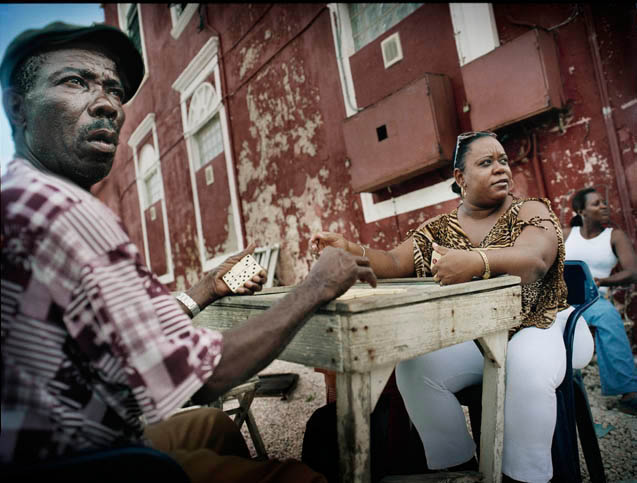
Caribbean Dominos - A Game of Slap and Slide!

Dominos is an all-Caribbean game, played from Cayman round to Curaçao, and particularly via Cuba, where even El Jefe, Fidel Castro, was known to be partial to a game.

You will see it in action in bars around the islands, at taxi stands and under trees on afternoons of leisure.

Actually, more accurately, you will hear it being played – West Indian dominoes is played with customary Caribbean demonstrativeness. A ‘card’ as it is called in Barbados, is not laid down on the game table. Most of the time it is slapped down and then slid into place.

It looks so simple...and yet...there is far more strategizing than you would ever imagine, and most importantly there is also an active mind at work. Even players clearly the worse for wear - or is that the worse for beer? - will be counting off the dominoes that have already been used and finessing the ones that remain, judging who might be holding them.

A word of warning, then. Do not ever, ever, take a West Indian on at dominos for money. Regular players just beat you every time.

Interested in the game rules? Have a look at John McLeod's Rules of Domino games: Jamaican and Caribbean Dominoes.

Monday, September 7, 2009

Irony in the Islands - Caribbean Maps Come Alive

It’s an eccentric view, to be sure, but I have often imagined the Caribbean islands as an animal skeleton. It sits, looking left, perched at Jamaica, its body Hispaniola (Haiti and the Dominican Republic) and its head and neck, Cuba, stretching out towards Mexico. Balanced by its tail, the many island vertebrae of the Eastern Caribbean, the western end of Cuba might be about to peck Cancun.

I wonder what animal it might be. It could be an iguana perhaps, or a tree-dwelling cat. But then its tail is prehensile - Trinidad is embedded, holding firm onto Venezuela in South America – so perhaps it is a tree porcupine or a pangolin – though it looks too ready to leap. It might even be a chameleon or a dinosaur. The Bahamas, which admittedly stand ceremonious on the fact that they are not actually part of the Caribbean, do look like one of those brightly coloured fan-shaped backplates.

Individual islands have their ironies too. Jamaica looks like a turtle, languishing calmly in the sea, momentarily surfacing to breathe – and it’s an image about as inappropriate as it is possible to be for the frenetic, ever-lively Jamaicans. Guadeloupe is well known as a butterfly (and there are nautical confusions there too), but its compatriot Martinique looks more like a flea in mid-leap. Or is that a skiing glove? And St Kitts and Nevis, in true form, are like bat and ball. All it would take is for St Kitts to pivot around its handle and it would knock Nevis into the mid-Atlantic.

But my favourite image is that of Cuba, which from the perspective of the rest of the Caribbean looks like an alligator hovering over them, threatening. It’s true, Cuba could be scary – as soon as it opens up fully it will threaten to swallow their livelihood by taking all their tourism. With one switch of its tail it could descend on them and gobble them all up. But then step back a bit and you will see the incisor of Florida hanging over Cuba, poised to chomp onto the Yucatan and bite it in half. And suddenly Cuba looks like a wriggling tiddler. And so it has been for the past 50 years. Thing is, looking at the map, Cuba might just manage to get away.

Tuesday, September 1, 2009

Harum Scarum - Caribbean Flight Frights

As a group of islands, you’d expect the Caribbean to have some, well... ‘sporting’ landing strips. And so it turns out. There are short runways, runways with cross-winds, runways with cliffs at either end, and runways that inconveniently have a hill in the way, just where you’d want the pilot to line up to land.

We have tested them all and have put together a roll of honour – the Caribbean’s top three scariest landings! And here they are. Enjoy...


1 St Maarten
There’s a rather short approach to this runway, so the beach-goers get a bit of a shock from time to time.

2 St Barths
You worry that as it comes in to land the plane will take the hat of the car drivers on the road below.

3 Culebra, off Puerto Rico
And yes, there’s a hill just where you want the pilot to line up here, so you swing around the hillside.

And before you go, if you would like to read a story about landing on Saba, a bright green pimple of an island whose airstrip is shorter than any self-respecting aircraft carrier, then have a look at Landing on Saba - Not Something for the Sane! which is the fourth video in the above playlist.
Bookmark and Share
Related Posts with Thumbnails